
Cardiology Office Hours is a series where I tackle the most common questions I encounter every day in my practice. I figured if my own patients benefit from this advice, you might as well! What you read here is exactly how I talk to my patients about their hearts, so it’s like you’re sitting right there in the clinic with me. Simple, and easy to understand English. I hope you find value in it! I hope you find it valuable, and please do share this widely with friends and family! Find me on TikTok or Instagram as well.
Hi everyone, Dr. Siyab, cardiologist here.
Going to the cardiologist can be very intimidating for many people, whether it’s your first visit ever, or you’ve seen one for 20 years. No one wants to have to see one, but sometimes you have to, if there is a heart issue.
Unfortunately, for a lot of people, the whole deal is often chaotic and confusing. People can leave feeling rushed and with more questions and uncertainty than answers when they walk out the door. This probably sounds very familiar.
But it doesn’t have to be this way! Let me help simplify this for you.
The Problem is Often the Process, Not the Issue Itself
In my own practice, I have realized that the problem isn’t often the heart issue itself , which can be usually figured out and treated. The problem is the seemingly disorganized and chaotic process, and more importantly, the lack of clear expectations and explanation of how the process works.
This is why when I see a new patient in my clinic, before I even discuss their actual issue, I explain to them how the PROCESS works - seeing me for the fist visit, my evaluation, etc. works, and set expectations.
If you, or a loved one or family member are about to see the cardiologist for the first time, this article is for you. Please share this article widely!
The Role of the Cardiologist: Detective Work.
If you are seeing a cardiologist for the first time, it is usually because you have been referred by your primary care physician or the ER because of a concern for a heart issue. You may be having one or more of any number of symptoms, such as chest discomfort, palpitations/heart fluttering, shortness of breath with exercising or just resting, dizziness, passing out, and the list goes on.
Now, these symptoms like chest pain, dizziness, palpitations, etc are incredibly common, and can be caused by any one of a million things! Some of these things are related to the heart, and many of them are not!
The first thing I tell patients is my role in the process. My job is to figure out if it is the heart. It is to get a detailed history, do a physical exam, review your records, and figure out if there is a significant heart issue that is causing your problems.
It Can Take Time (And Patience!)
As you can imagine, sometimes this can take a little bit of time to figure things out. Sometimes it’s easy and slam dunk, and I have a pretty good idea of what might be going on before I even enter the room. Great! Easy!
But often, it’s not very clear at all initially. More often than not, heart conditions are complex.
We often need more information from you, or multiple tests. An EKG is just a snapshot in time of your heart’s electrical activity and may or may nor give us a clue. We may need echocardiograms, stress tests, or heart monitors to see the full picture.
Tests can be inconclusive. Medicine isn’t always black and white. Sometimes a test result requires further investigation.
Trial and error is normal. Finding the right medication or ruling out specific triggers can take anywhere from a few weeks to a few months. Sometimes new information can reveal itself a few weeks into the process.
This is normal
However, it can extremely be frustrating for patients. You’ve obviously been feeling your symptoms for a while, and you are just looking for answers, and not getting immediate answers is defeating. I totally get that.
Remember though, that I just met you, and I don’t know you that well just yet! If it is a true emergency life-or-death situation such as you’re having a heart attack, you would not be in my clinic. You’d be in the ER and things would be moving very fast.
Unless it is something that is clear cut and it is often not, it will not be solved in just the first visit. It can take a few visits and back and forth to figure it out.
What I do promise every patient is this: If I am concerned about anything serious or life-threatening, we will move immediately. I will do everything in my power to ensure you get the appropriate testing right away.
The Problem with the “15 Minute” Visit
Modern healthcare tries to stuff complex human beings into neat 15-minute appointment slots. It is nearly impossible to gather a detailed history, review your records, perform an exam, and explain a treatment plan in 15 minutes. But it is the system that we all have to work in.
On top of that, it is overwhelming to be put on the spot. You might not remember every detail of your symptoms or your family’s medical history when a doctor is firing questions at you. This is why patients feel rushed.
The end result of all this is that patients can feel very rushed, and leave the clinic having more questions than answers, and that is obviously not comforting.
A Simple Solution: Coming Prepared - Free Worksheet
To make this process smoother, less stressful, and far more productive, I created an easy-to-use worksheet. You can download it, print it, and fill it out at your kitchen table before your appointment. This way you have time to think without being rushed to do everything in that 15 minute slot.
It covers:
Your specific symptoms and when they happen.
Key details about your medical and family history.
Your specific concerns and expectations for the visit.
Any other details you want the doctor to know
When you hand this to your cardiologist at the start of your visit, they immediately have the critical information they need. It gives me more time to actually talk with you, rather than just asking questions and trying to look up stuff in the computer. I already know some of the most important things I need to know about you, because of this little worksheet.
This is what it looks like:
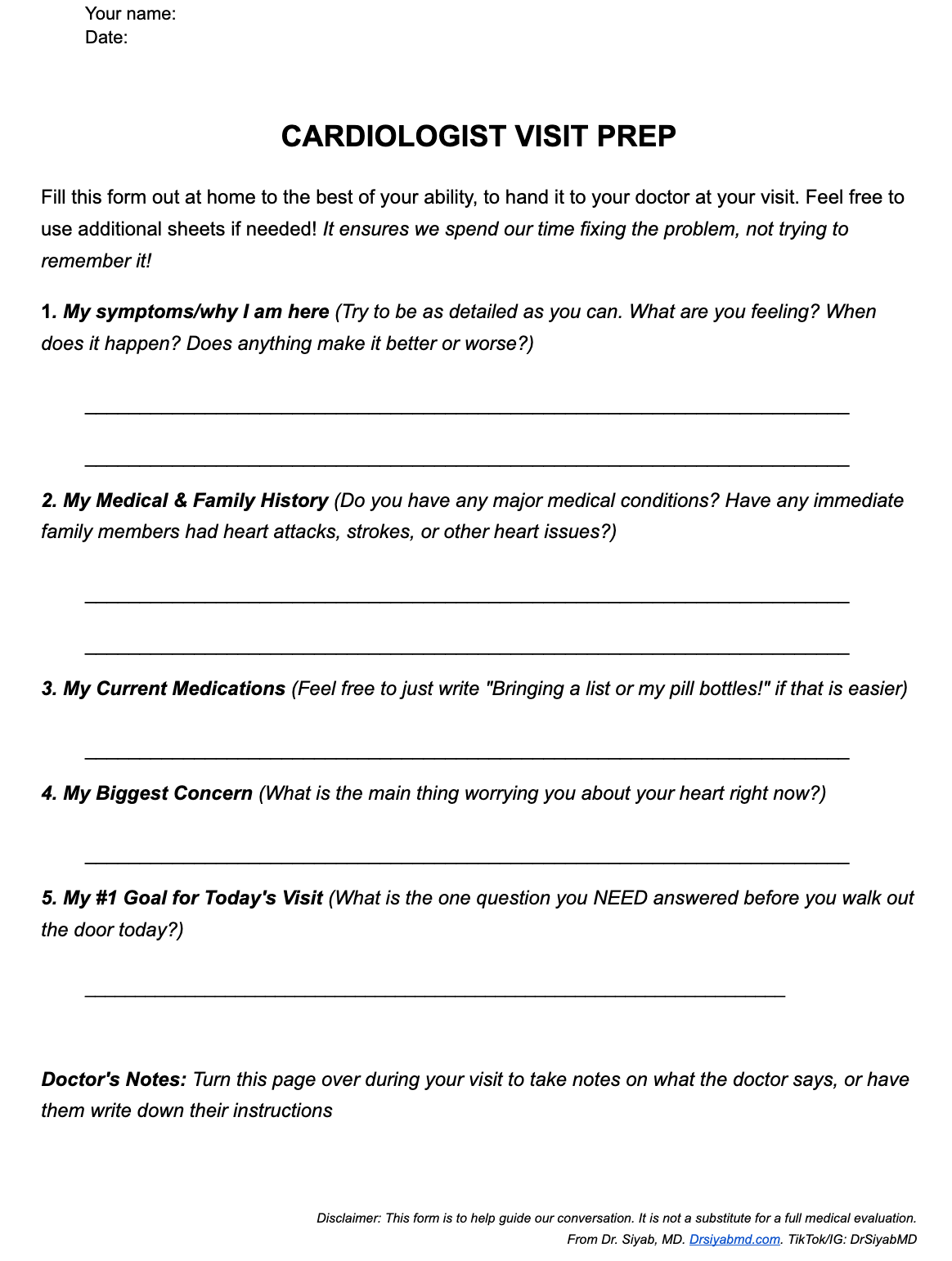
And it’s free! You can download it on the resources page here
So what happens when all the testing is done?
After all is said and done, this is what the possibilities look like:
We find a serious issue. Conditions like severe coronary artery disease need prompt attention. My job is to figure out exactly what it is and get you the treatment you need immediately.
We find a benign issue. Many heart conditions cause very real, uncomfortable symptoms, but they aren’t dangerous or life-threatening. A great example is SVT (a common abnormal heart rhythm). It can make you feel terrible, but it is highly treatable and won’t harm your heart long-term.
We find nothing pathologically wrong with your heart. Sometimes, we do all the testing and the heart looks perfect or only has mild insignificant abnormalities. Could your symptoms be coming from your GI tract, your lungs, or stress? Anxiety is also a very real medical condition that can cause physical symptoms that feel like heart issues. It’s not something I blame upfront, of course, but it definitely can play a role. If I think it’s a non-heart related issue, I will defer back to your primary care doctor to explore those avenues.
Sometimes, I don’t have an answer
Sounds crazy I know, but it happens. We do all of the testing possible to look for a heart issue, and everything comes back normal or only mildly abnormal findings that are really just wear and tear on the heart and not clinically significant. What I can say though, is that we’ve looked at your heart in detail and haven’t found any dangerous pathology. Which by itself should be reassuring - most people don’t want to have bad heart problems, of course!
What that usually means is that it might be a benign abnormality (such as extra heart beats), that might feel like a nuisance but are not actually harmful, or there is something else going on that’s got nothing to do with the heart.
Is it possible that heart issues can be “missed”?
Also yes - not common, but happens. It is unlikely if you’ve had extensive testing, but sometimes things can hide for a while and may only become apparent later on. But the chances are pretty low if you’ve had a thorough evaluation.
Questions?
That’s all for this edition! I hope this was useful. If you have any questions, ideas, or comments on what else you would like me to discuss, let me know below in the comments!
DISCLAIMER: The information provided here is educational only and not medical advice. It is not a substitute for professional medical advice, diagnosis, or treatment. Always seek the advice of your physician or other qualified health provider with any questions you may have regarding a medical condition.
Make sure to check out other articles for more tips, and also the Free Resources section for useful educational resources and tools! Find me on TikTok or Instagram as well.
If you liked this post, please consider sharing it!
If you are new here and not an e-mail subscriber yet, please feel free to subscribe and join 8500+ others for FREE, so you can get any new posts or updates on new resources straight to your inbox! No spam, promise.
This is so helpful! The question sheet is a great idea. Thank you 😊